
Redefining Business Intelligence
for the Agentic AI Era
For two decades, business intelligence has asked people to do the hard part. Analysts built the dashboards, executives interpreted the charts, and someone, eventually, decided what to do about it. The data was visible, but the distance between seeing a number and acting on it stayed stubbornly wide. Tableau Next is built to change that — combining AI, conversational analytics, and intelligent automation to transform analytics from passive reporting into active decision support.
Announced by Salesforce and now progressively reaching general availability, Tableau Next is positioned as the first agentic analytics platform: a reimagining of Tableau for an era in which AI agents work alongside people. Rather than simply presenting information, it interprets it, explains it, monitors it, and helps trigger the next action.
What Is Tableau Next?
Tableau Next is a cloud-native, agentic analytics platform built on Salesforce’s Agentforce 360 Platform. It is the first business intelligence product to span the complete analytics journey — from raw data ingestion, through a governed semantic layer, visualization, to workflow action — within a single unified environment.
Four architectural building blocks define the platform and are worth understanding.
Connects to data wherever it lives — Snowflake, BigQuery, Redshift, Databricks, Salesforce CRM, uploaded files, REST APIs — without duplicating it unnecessarily. Powered by Hyperforce, it delivers enterprise-grade security and compliance out of the box.
An AI-infused semantic layer that translates raw fields and database schemas into business-friendly terms. This is the layer that makes AI answers trustworthy: every agent response is grounded in your organization's own validated definitions of revenue, margin, quota, and whatever else your business measures.
Three pre-built AI agents — Data Pro, Concierge, and Inspector — that handle data preparation, natural-language Q&A, and continuous metric monitoring respectively. These run 24/7 inside the platform.
Insights don't just inform — they can trigger something. Through Salesforce Flow, a finding can initiate an approval, fire an alert, update a record, or begin a restock process directly from the analytics view.
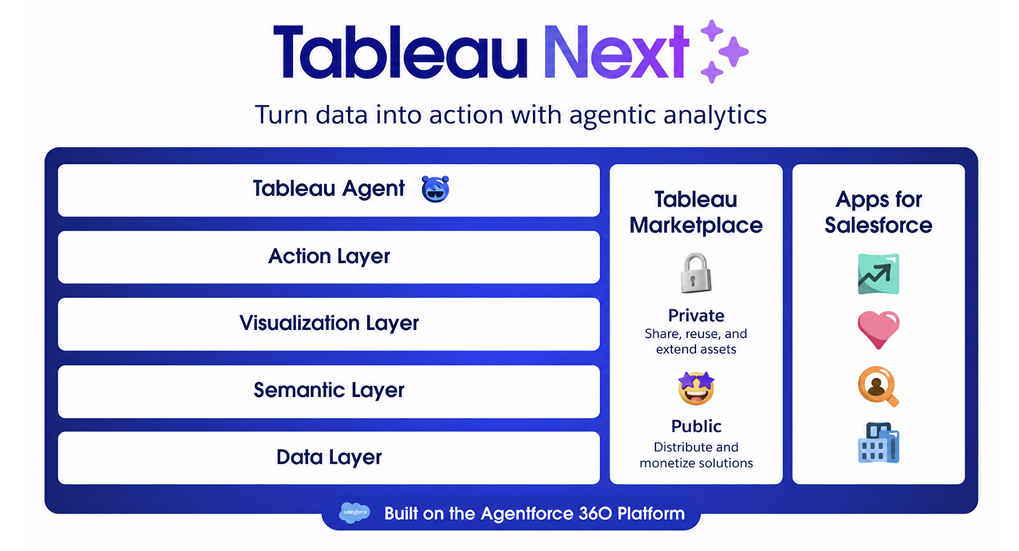
In Short : Tableau Next is not a BI upgrade. It is a decision layer where raw data becomes governed context, governed context becomes AI-powered insight, and insight becomes action.
How Tableau Next Helps Your Company
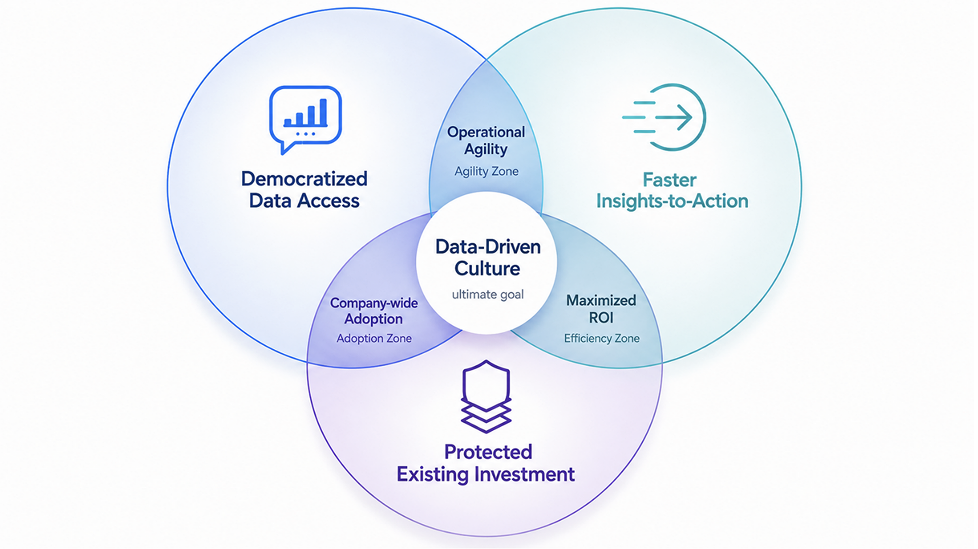
The business case for Tableau Next is not about better charts. It is about eliminating the organizational friction that sits between data and action - the ticket queues, the waiting periods, the “can someone pull a report on this?” moments that quietly cost velocity every single day.
-
Democratizing data access Today, advanced analytics is often limited to trained analysts, while business users wait for reports and answers. Tableau Next enables leaders across sales, finance, and operations to ask questions in plain language and explore trusted data directly - reducing dependency on ticket queues and freeing analysts for higher-value strategic work.
-
Compressing the insight-to-action cycle When detection, explanation, and action live inside the same platform, the lag between a problem emerging and a response being triggered shrinks from days to minutes. Inspector spots the anomaly. Concierge explains the root cause. Salesforce Flow initiates the workflow. No swivel-chair. No meeting to schedule. No narrative to write first.
-
Protecting your existing investments Tableau Next is built to extend, not replace. Existing Tableau Cloud and Server deployments, CRM Analytics, and Salesforce data can all feed into Tableau Next, meaning organizations can adopt agentic analytics progressively - layering in new capability without discarding what already works.
Benefits - and Why Conversational AI Can Finally Be Trusted
The promise of conversational analytics has circulated for years. The reason it has struggled to move beyond demos is simple:
- The answers could not be trusted.
- A general-purpose AI model talking to a poorly governed database will confidently produce wrong answers.
- That is not a foundation on which a CFO, a sales VP, or a supply chain director will stake a decision.
The Semantic Layer Is the Difference
Tableau Semantics solves the trust problem by embedding the organization's own business logic into the AI context. When someone asks Concierge about "gross margin by region," it does not improvise a definition - it uses the exact, validated calculation your finance team has approved.
What This Unlocks in Practice
Natural-language access to governed data means a conversational AI layer can be stood up without months of custom engineering.
Inspector monitors continuously and surfaces issues before anyone must look for them, pushing findings to the right people automatically.
Answers arrive in Slack, Microsoft Teams, PowerPoint, and Word - wherever your teams already spend their working day.
Every user can interrogate data independently while the semantic layer and permission model ensure nothing leaks and nothing conflicts.
What Is Generally Available Today - and What Matters Most
Tableau Next has moved decisively from announcement to availability. The table below captures the core GA capabilities, with the features of most strategic importance called out.
| Capability | What It Does | GA-Status |
|---|---|---|
| Tableau Next MCP | Connects any MCP-compatible AI agent directly to Tableau’s analytics engine, delivering answers grounded in your business context via the Agentforce Trust Layer. | ✓ Generally Available |
| Concierge (NL Q&A) | Natural-language questions answered with relevant visualizations, root-cause analysis, and next-best-action suggestions. Page Filters and Semantic Model Scope now GA for precise, governed responses. | ✓ Generally Available |
| Data Pro | AI-assisted data preparation, semantic modeling, and auto-generated relationships. Auto-Generate Semantic Models from Workspaces available in Beta. | ✓ Generally Available |
| Inspector | Proactive real-time metric monitoring with threshold alerts. Inspector in Slack (natural-language alerts delivered directly to DMs) in Beta. | ✓ Generally Available (Slack: Beta) |
| Tableau Semantics | AI-infused semantic layer with Rule-Based Semantic Model Authoring for enterprise-scale governance. The trusted foundation for all agent responses. | ✓ Generally Available |
| Sales Insights & Forecasting | Pre-built sales analytics with pipeline forecasting, Gap to Quota, and Pipeline Coverage. Predictive forecasting applies to any chart type without redesigning dashboards. | ✓ Generally Available |
| Visualization Enhancements | Sankey charts for flow and journey analysis; dynamic table color values; Groups & Bins in Viz Builder; Parameter Actions for click-driven what-if scenarios; Input Support for manual scenario modeling. | ✓ Generally Available |
| Microsoft 365 & Slack | Embed live dashboards and Pulse metrics into PowerPoint, Word, and Teams with one-click refresh. Inspector alerts and Concierge Q&A in Slack DMs. | ✓ Generally Available (Microsoft 365) Slack Inspector: Beta |
| Security & Connectivity | Private Connect to Snowflake and Redshift; IP Filtering Self-Service; Dashboard Extensions for operational write-back; centralized Data Monitoring command center. | ✓ Generally Available |
**Drawn directly from Tableau's official April 2026 release page.
Beyond the table, two beta capabilities are worth tracking closely:
- Q&A Calibration which lets data experts validate and fine-tune agent responses against curated test questions.
- Personal Orgs which gives individual analysts a governed sandbox to build and test before assets go to production. Both signal where the platform is heading next.
Licensing - What You Need to Know
Tableau Next can be purchased standalone or, most commonly, as part of the Tableau+ Bundle, which packages Tableau Cloud and Tableau Next together so organizations can extend agentic analytics across their entire user base. A clear pricing shift took effect in 2025: consumption-based charges for queries, transforms, and agentic analytics have been eliminated, replaced by straightforward role-based pricing that makes adoption at scale far easier to forecast and budget.
A Creator can build, publish, and manage analytics content and agentic experiences. A Consumer can access and use that content. Every deployment requires at least one Creator. Additional users can be added as either role.
Because Tableau Next’s data layer runs on Data 360, storage and certain Data 360-related costs may apply in addition to user licenses.
Annual contracts are required, and Tableau+ Bundle pricing is finalized directly with Salesforce. Tableau Next is also available within Agentforce1 Editions and Marketing Intelligence for organizations already in those ecosystems.
Licensing for Tableau Next rewards careful planning. The right distribution of Creator and Consumer roles, the footprint of your Data 360 usage, and how Tableau Next sits alongside your existing Tableau and Salesforce investments all shape the total picture - which is exactly where experienced guidance pays for itself.
What to Get Right Before You Start
Tableau Next is a powerful platform and a genuine leap forward - but it rewards preparation and penalizes shortcuts. Based on the platform’s architecture, official guidelines, and real-world adoption experience, here are the considerations every organization should work through before committing.
| Consideration | What It Means for Your Adoption Plan |
|---|---|
| Salesforce org required | Tableau Next runs on the Salesforce Agentforce 360 Platform, which means a Salesforce org with Data 360 must be provisioned, even if your company is not a Salesforce CRM customer. Factor this into your onboarding timeline and admin resourcing. |
| Data quality drives AI quality | Concierge and other agents surface inconsistencies at scale rather than hiding them. If your data has conflicting metric definitions or poor field naming, the semantic model will need careful construction before conversational AI produces trustworthy answers. |
| Connector gaps to verify | Data 360 supports Snowflake, BigQuery, Redshift, Databricks, PostgreSQL, MySQL, and more - but some classic Tableau connectors are not yet available in Tableau Next. SQL Server on AWS (live and ingest) is still on the roadmap. Validate your specific stack before finalizing plans. |
| Data models may need rethinking | Classic Tableau workbooks built on joins and denormalized tables do not translate directly into Tableau Next's relationship-based semantic model. Migrating existing content requires re-evaluation and resourcing, though the result is better-governed, AI-ready data. |
| Data 360 storage costs apply separately | Role-based licensing removes consumption charges for queries and AI. However, data storage and certain Data 360 service costs are billed separately. At enterprise ingest volumes these can be significant, model them explicitly when building your business case. |
| Governance must be designed in | Row-level security, permission-aware access, and semantic model scope controls are available but must be actively configured. Deploying conversational analytics before governance frameworks are in place erodes trust rather than builds it. |
Our Take on Tableau Next
We have watched a lot of "next generation analytics" announcements come and go. What makes Tableau Next different is not the AI - it is the architecture beneath it. The decision to build a governed semantic layer as the foundation of every agent interaction is the detail that separates a platform worth trusting from one that produces impressive demos and unreliable production results.
Salesforce is positioning Tableau Next not just as a standalone analytics product, but as the analytics intelligence layer for any AI agent in your ecosystem. That is a significant strategic bet, and in our view, the right one.
How OSI Digital Can Help You on This Journey
OSI Digital has built its practice around this intersection of Tableau and Salesforce. As a long-standing Tableau partner, recognized with a Tableau Americas Partner of the Year award and a Salesforce consulting partner, we have spent years helping organizations across healthcare, life sciences, manufacturing, retail, and financial services turn data into outcomes.
We can support you at whatever stage you are at:
-
Assessment and roadmapA clear-eyed evaluation of whether Tableau Next fits your goals, your data estate, and your existing Tableau and Salesforce investments.
-
Licensing and cost guidanceScoping the right balance of Creator and Consumer roles and Data 360 footprint so you adopt with confidence and predictable cost.
-
Semantic foundation buildBuilding the clean, governed Tableau Semantics layer that makes every agent answer trustworthy - the investment that pays forward into every AI use case you tackle.
-
Implementation and enablementDeploying Concierge, Inspector, Data Pro, and MCP integrations in a governed way, and enabling your teams so adoption sticks.
The organizations that will lead in the agentic era are building their data foundations now. If your organization is ready to explore what Tableau Next could mean for your business, the OSI Digital Data Analytics team is ready to start that conversation.